Why legal faxes carry a privilege notice
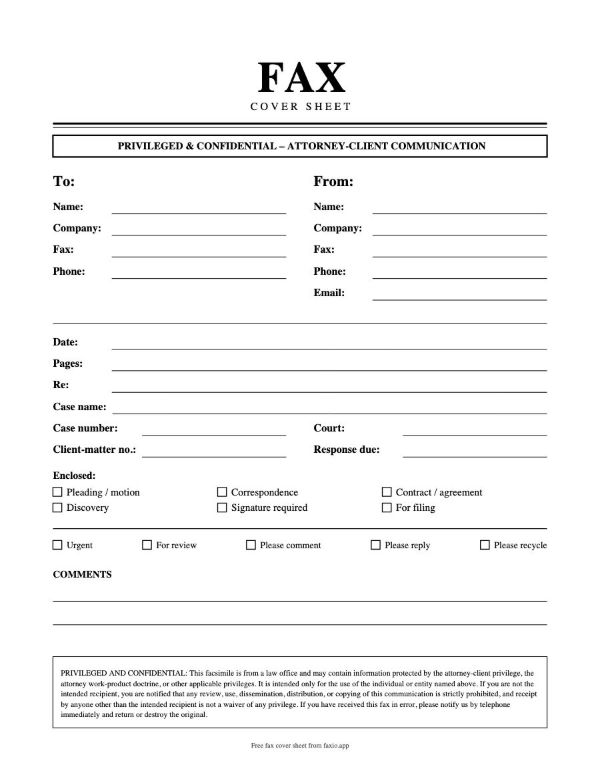
A privilege notice does not make a document privileged, and it will not rescue a disclosure on its own. What it does is record that the sender treated the communication as confidential and tell an accidental recipient what to do. That matters if you later need to claw back an inadvertently sent document under Federal Rule of Evidence 502(b) or a state equivalent, where courts look at the precautions you took.
Use the notice on faxes to clients and co-counsel. For routine service on opposing counsel or a filing with the clerk, many firms switch it off, since the contents are not privileged.
The fields that get a fax to the right file
- Case name: the short caption, such as Smith v. Jones.
- Case number: exactly as it appears on the docket, including the division or judge's initials.
- Court: the court and county or district, so a mailroom serving several courts routes it correctly.
- Client-matter number: your firm's internal billing reference, useful when faxing to your own office or to co-counsel.
- Response due: the deadline, if the recipient needs to act.
Tick what is enclosed (pleading, correspondence, discovery, a document to sign) and give the page count including the cover.
When you fax opposing counsel, address it to the attorney of record by name. A fax addressed only to the firm may sit with a receptionist, and if the document starts a response period you want a clear record of who it was sent to.
Faxing to a court
Many courts now require e-filing and accept fax filings only from self-represented parties or in an emergency. Some still use fax filing agencies. Check the local rules for page limits, fees and whether a fax-filed document needs the original to follow. Courts generally treat the time the last page arrives as the filing time, so do not leave a deadline filing to the last minute.
Keep the transmission confirmation. If service is ever disputed, the confirmation page with the date, time, number and page count is your proof.
Frequently asked questions
Does a confidentiality notice protect attorney-client privilege?
Not by itself. Privilege depends on the communication, not the label. The notice shows you took reasonable precautions, which courts consider when deciding whether an inadvertent disclosure waived privilege.
What goes on a legal fax cover sheet?
The sender and recipient details, the date and total page count, the case name and number, the court, a short description of what is enclosed, and, for privileged material, a confidentiality notice.
Can I fax a court filing from my computer?
If the court accepts fax filings, yes. Fill in this cover sheet, attach the filing as a PDF and send it through Faxio. Check the court's local rules first, since many require e-filing instead.
Is there a Word version of the legal cover sheet?
Yes. Choose Word (.docx) under the preview to download an editable file you can save with your firm's letterhead.